
Welcome to my personal website. I am Leverhulme Trust and Isaac Newton Trust Early Career Fellow at the Department of Land Economy, and Governing Body Fellow of Hughes Hall, University of Cambridge. I am currently a LSE–Miguel Dols Fellow at the Cañada-Blanch Centre, LSE, and an affiliated researcher at the Lab of Interdisciplinary Spatial Analysis at the University of Cambridge. I previously served as a Visiting Fellow at the Department of Social Policy and Intervention, University of Oxford.
My research applies GeoAI, GIS, big data, and causal inference methods to understand the causes and consequences of spatial inequality. Specifically, adopting a global comparative perspective that examines regions across both the Global North and South, my research seeks to develop a more holistic understanding of (1) how digital transformation is reshaping spatial inequality; (2) the political and economic consequences of spatial inequality; and (3) how public policy instruments can be leveraged to promote inclusive and sustainable regional development and redress spatial inequality. My work spans multiple disciplines, as I believe that the originality and novel disciplines of the future will emerge from the mix of diverse fields today.
I am the sole Early Career Plenary Speaker at the opening session of the 2025 Regional Studies Association Annual Conference, and I have also been invited to present my research findings at the Human Development Report Office of the United Nations Development Programme (UNDP), University of Oxford, Tsinghua University, Chinese Academy of Sciences, among other distinguished institutions. I have provided consulting services for international organizations such as the OECD and the Asian Development Bank, and my research has been featured and cited in their flagship reports.
I received my Ph.D. in Land Economy from the University of Cambridge with no corrections (Winner of 2025 Regional Science Association International (RSAI) Best Dissertation Award), M.Sc. in Development Economics from Birmingham University with Distinction, and B.A. in Information Management and Information Systems from Renmin University of China. I have done occasional research for the International Inequalities Institute and the Department of Geography and Environment at the London School of Economics, the Cambridge Judge Business School, Tsinghua University’s Institute for China Sustainable Urbanization, and Peking University’s Institute of New Structural Economics.
I was raised by my elderly, amiable, and illiterate grandparents in a small rural village in southeastern China, where I attended local primary and junior high schools before being selected to a prestigious senior high school in the city. This early experience helps me get the start understanding of spatial inequality. As an economic geographer, I sincerely hope that through collective efforts across academia and policymaking, we can build a more geographically equitable world where individuals, regardless of their origins, have equal access to opportunities and can share in the benefits of socioeconomic prosperity.
Warning
Problem: The current name of your GitHub Pages repository ("Solution: Please consider renaming the repository to "
http://".
However, if the current repository name is intended, you can ignore this message by removing "{% include widgets/debug_repo_name.html %}" in index.html.
Action required
Problem: The current root path of this site is "baseurl ("_config.yml.
Solution: Please set the
baseurl in _config.yml to "Selected Work in Progress
Formative Cities: Early-Life Exposure to Urban Density and the Making of Universalist Outlooks
Davide Luca, Zhiwu Wei, Neil Lee, Andrew McNeil
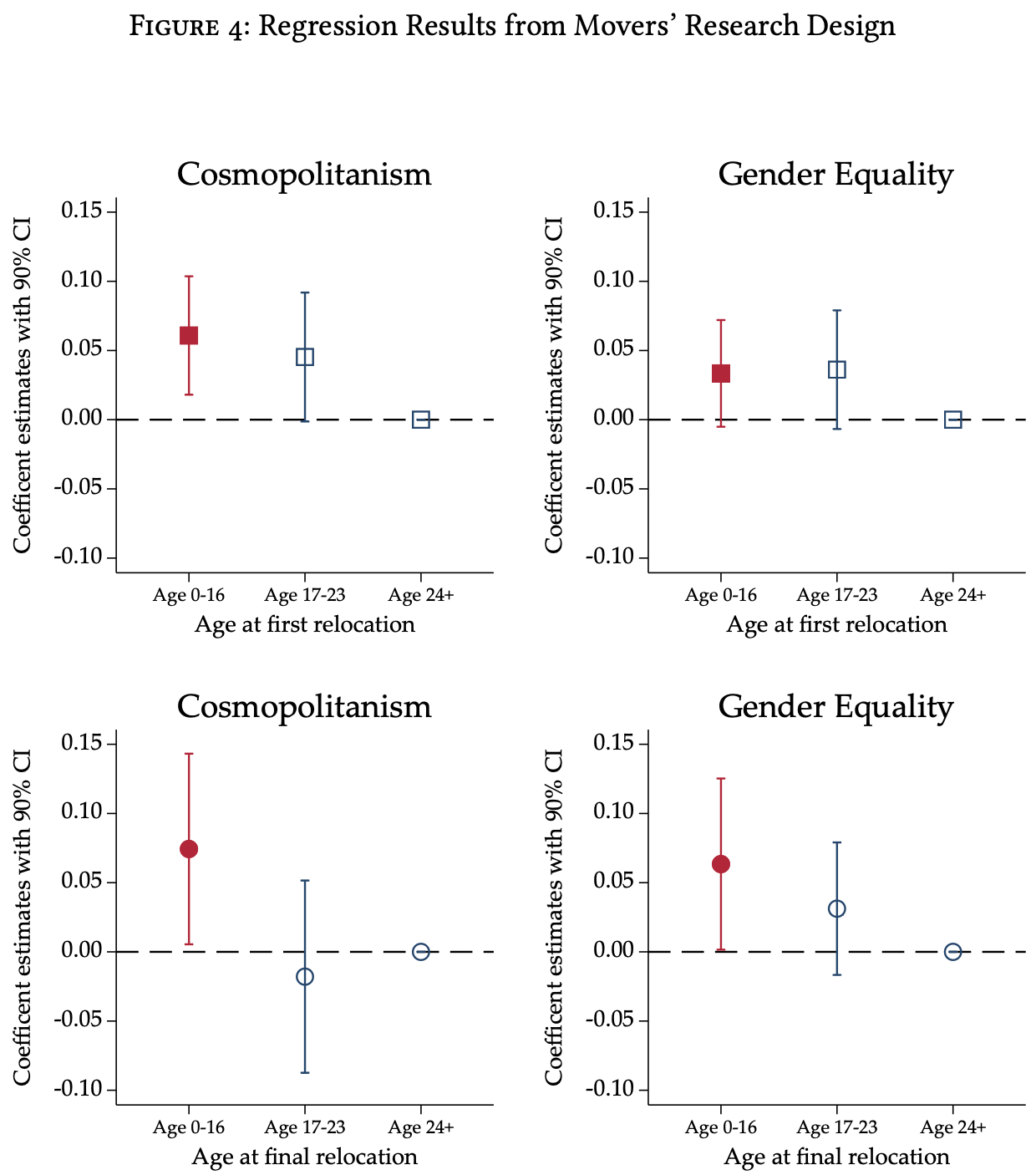
Does place influence social and political outlooks? There is increasing evidence of a correlation, but little consensus on causation. Residents of large cities are, on average, more likely to hold values linked to universalism, rather than particularism. Yet, it has proven hard to isolate compositional effects from contextual effects. We provide novel causal evidence showing that exposure to urban density influences individual outlooks beyond compositional effects, but this influence is only driven by the environments where individuals spend their preadult life. We do this by using household panel data from both Switzerland and the UK, which allows us to combine 'Movers' and Two-Stage-Least-Squares research designs. We show with two different approaches that exposure to urban density before age 20 causally increases support for cosmopolitanism, gender equality and LGBTQ+ rights, highlighting the lasting influence of place early in life.
Formative Cities: Early-Life Exposure to Urban Density and the Making of Universalist Outlooks
Davide Luca, Zhiwu Wei, Neil Lee, Andrew McNeil
Does place influence social and political outlooks? There is increasing evidence of a correlation, but little consensus on causation. Residents of large cities are, on average, more likely to hold values linked to universalism, rather than particularism. Yet, it has proven hard to isolate compositional effects from contextual effects. We provide novel causal evidence showing that exposure to urban density influences individual outlooks beyond compositional effects, but this influence is only driven by the environments where individuals spend their preadult life. We do this by using household panel data from both Switzerland and the UK, which allows us to combine 'Movers' and Two-Stage-Least-Squares research designs. We show with two different approaches that exposure to urban density before age 20 causally increases support for cosmopolitanism, gender equality and LGBTQ+ rights, highlighting the lasting influence of place early in life.
Local Wealth Inequality Linked to Political Protests across the Global South
Zhiwu Wei, Davide Luca, Neil Lee, Andrés Rodríguez-Pose
Reject and Resubmit, Nature
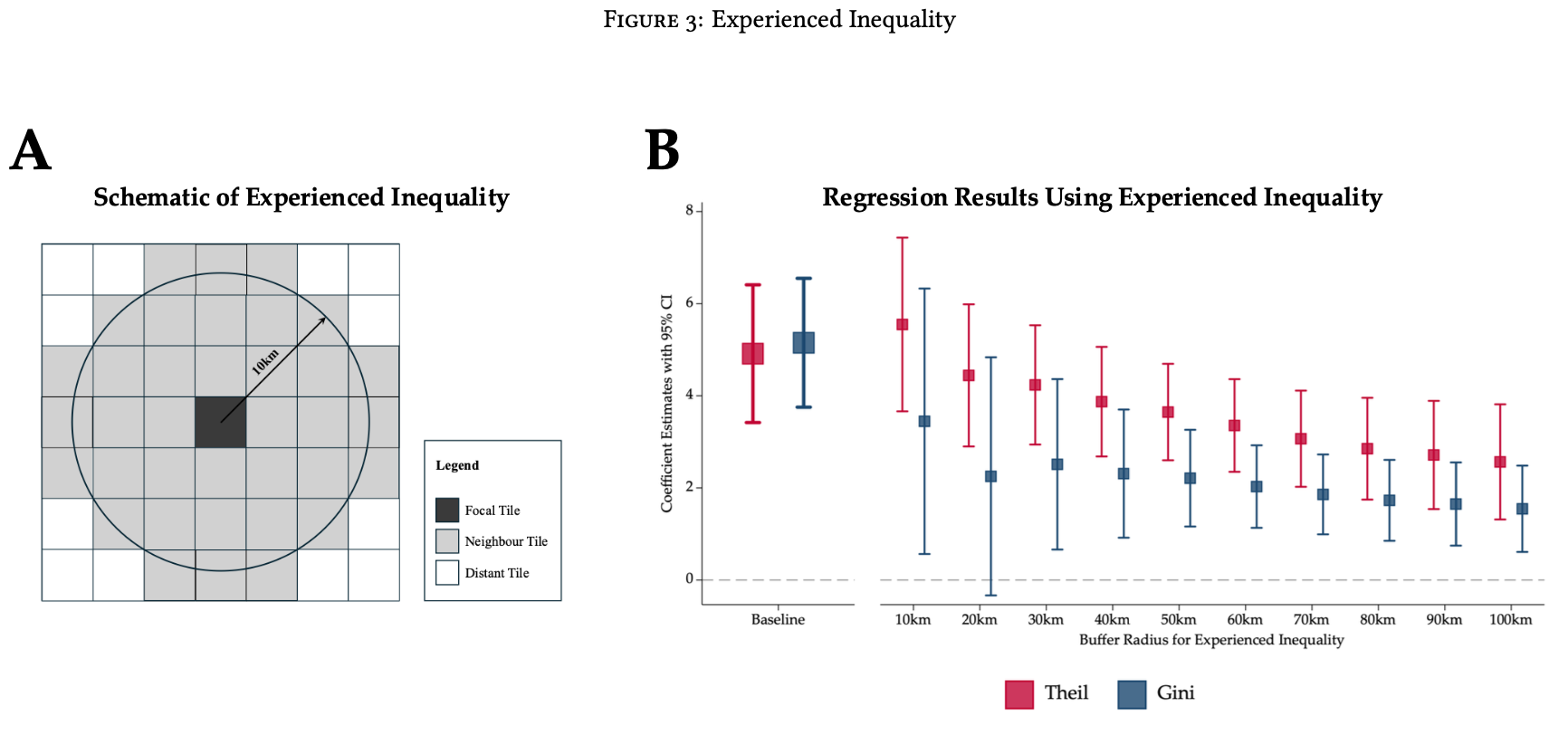
The political consequences of inequality have become a matter of mounting concern. Relative deprivation theory posits that frustration arising from comparisons with proximate reference groups can fuel protests. Yet research has concentrated overwhelmingly on the Global North, notwithstanding the acute wealth disparities experienced by the majority of the world's population in the Global South. To address this gap, we assemble novel, fine-grained estimates of relative wealth at the 2.4 km X 2.4 km grid level to derive measures of local wealth inequality, which we link to over 645,000 georeferenced protest events recorded from 2014 to 2018. Exploiting variation within subnational regions, we document a robust, positive association between local wealth inequality and protest incidence. We show that the inequality–protest relationship is anchored in individuals’ immediate surroundings. As the spatial radius defining 'local' expands, the association weakens, highlighting the primacy of experienced inequality. We also find that the inequality-protest link is mediated by national characteristics. The study advances the social sciences by furnishing novel empirical evidence on the micro-geographic underpinnings of political instability, demonstrating that inequality’s political effects hinge on proximity, local class structure and national institutional environment.
Local Wealth Inequality Linked to Political Protests across the Global South
Zhiwu Wei, Davide Luca, Neil Lee, Andrés Rodríguez-Pose
Reject and Resubmit, Nature
The political consequences of inequality have become a matter of mounting concern. Relative deprivation theory posits that frustration arising from comparisons with proximate reference groups can fuel protests. Yet research has concentrated overwhelmingly on the Global North, notwithstanding the acute wealth disparities experienced by the majority of the world's population in the Global South. To address this gap, we assemble novel, fine-grained estimates of relative wealth at the 2.4 km X 2.4 km grid level to derive measures of local wealth inequality, which we link to over 645,000 georeferenced protest events recorded from 2014 to 2018. Exploiting variation within subnational regions, we document a robust, positive association between local wealth inequality and protest incidence. We show that the inequality–protest relationship is anchored in individuals’ immediate surroundings. As the spatial radius defining 'local' expands, the association weakens, highlighting the primacy of experienced inequality. We also find that the inequality-protest link is mediated by national characteristics. The study advances the social sciences by furnishing novel empirical evidence on the micro-geographic underpinnings of political instability, demonstrating that inequality’s political effects hinge on proximity, local class structure and national institutional environment.
Journal Articles
Mobile Internet Connectivity and Household Wealth in the Philippines
Zhiwu Wei, Neil Lee, Yohan Iddawela
Journal of Development Economics, Vol.185: 103946 (February 2027)
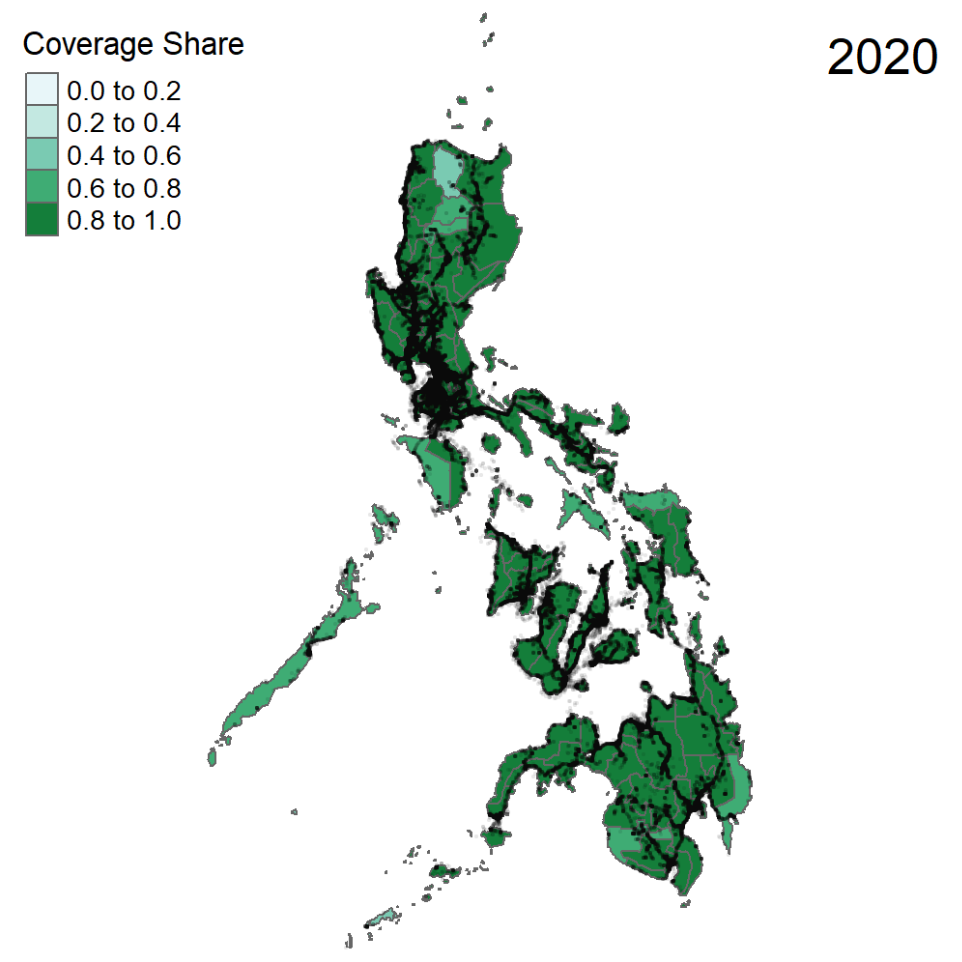
Mobile internet has become a fundamental modern infrastructure. We consider how access influences household wealth in the Philippines using a granular measure of local connectivity based on geocoded cell towers and identify causal impact through an instrument based on proximity to submarine cable landing points. Our results show that mobile internet connectivity increases household wealth, with effects across education levels and most pronounced in urban areas. We investigate potential mechanisms and find that improved connectivity stimulates activity in key economic sectors, improves educational outcomes, and increases female labor force participation, primarily in occasional work. Given the context of the Philippines as a major migrant-sending country, we conduct a complementary event study which suggests that tower rollout may facilitate international labor migration and increase remittance flows to origin households.
Mobile Internet Connectivity and Household Wealth in the Philippines
Zhiwu Wei, Neil Lee, Yohan Iddawela
Journal of Development Economics, Vol.185: 103946 (February 2027)
Mobile internet has become a fundamental modern infrastructure. We consider how access influences household wealth in the Philippines using a granular measure of local connectivity based on geocoded cell towers and identify causal impact through an instrument based on proximity to submarine cable landing points. Our results show that mobile internet connectivity increases household wealth, with effects across education levels and most pronounced in urban areas. We investigate potential mechanisms and find that improved connectivity stimulates activity in key economic sectors, improves educational outcomes, and increases female labor force participation, primarily in occasional work. Given the context of the Philippines as a major migrant-sending country, we conduct a complementary event study which suggests that tower rollout may facilitate international labor migration and increase remittance flows to origin households.
Ballots, Budgets and Bricks: Brexit and the Polarisation of Individual Economic Behaviours
Pei Kuang*, Davide Luca*, Zhiwu Wei* (* alphabetical order)
Journal of Public Economics, Vol.259: 105666 (July 2026)
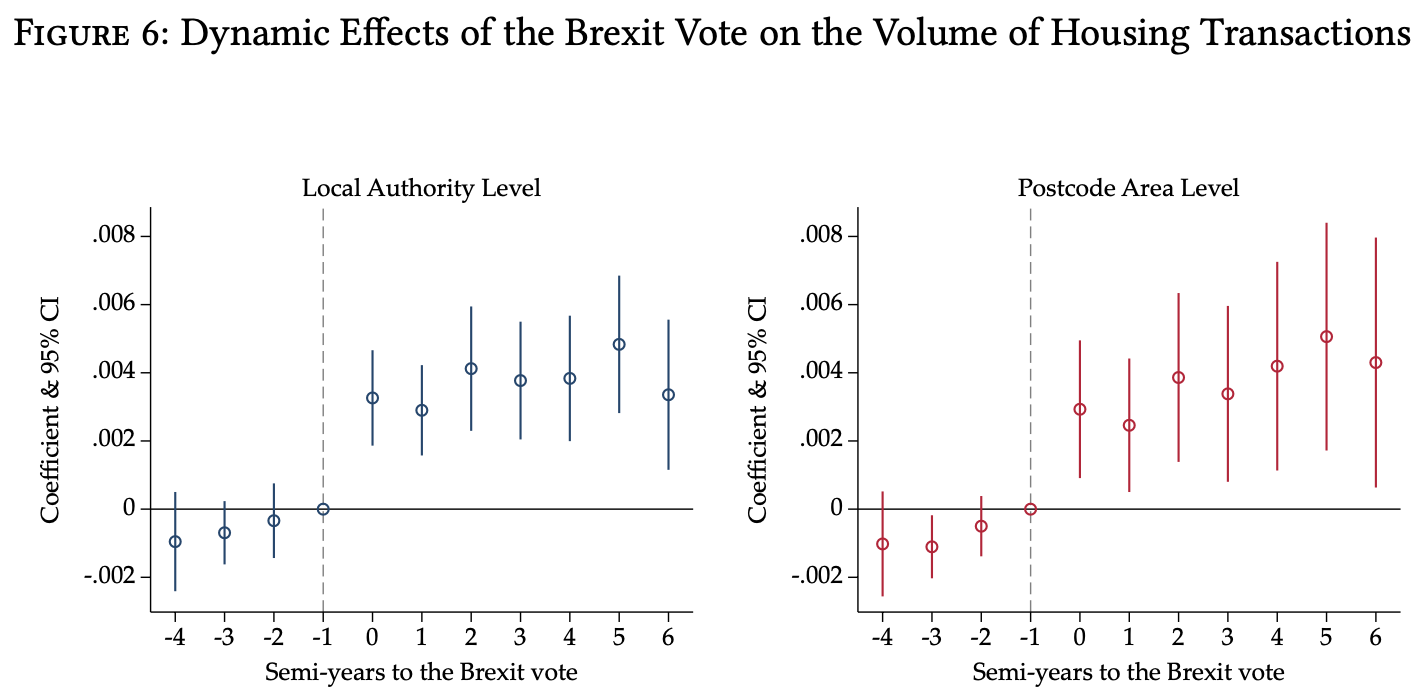
Does political polarisation influence actual economic behaviours? Using British nationally representative surveys and administrative data, we document how the Brexit referendum triggered stark divergences in individual micro and macro expectations between Leave and Remain supporters. Compared to existing research, we show how these polarising effects were driven by a specific policy issue and only marginally related to traditional partisan identities. We also demonstrate how these diverging beliefs influenced major real financial decisions. Leavers became more likely to purchase durable goods and engage in housing transactions, and areas with higher proportions of Leave voters experienced increased housing transaction volumes and rising prices.
Ballots, Budgets and Bricks: Brexit and the Polarisation of Individual Economic Behaviours
Pei Kuang*, Davide Luca*, Zhiwu Wei* (* alphabetical order)
Journal of Public Economics, Vol.259: 105666 (July 2026)
Does political polarisation influence actual economic behaviours? Using British nationally representative surveys and administrative data, we document how the Brexit referendum triggered stark divergences in individual micro and macro expectations between Leave and Remain supporters. Compared to existing research, we show how these polarising effects were driven by a specific policy issue and only marginally related to traditional partisan identities. We also demonstrate how these diverging beliefs influenced major real financial decisions. Leavers became more likely to purchase durable goods and engage in housing transactions, and areas with higher proportions of Leave voters experienced increased housing transaction volumes and rising prices.
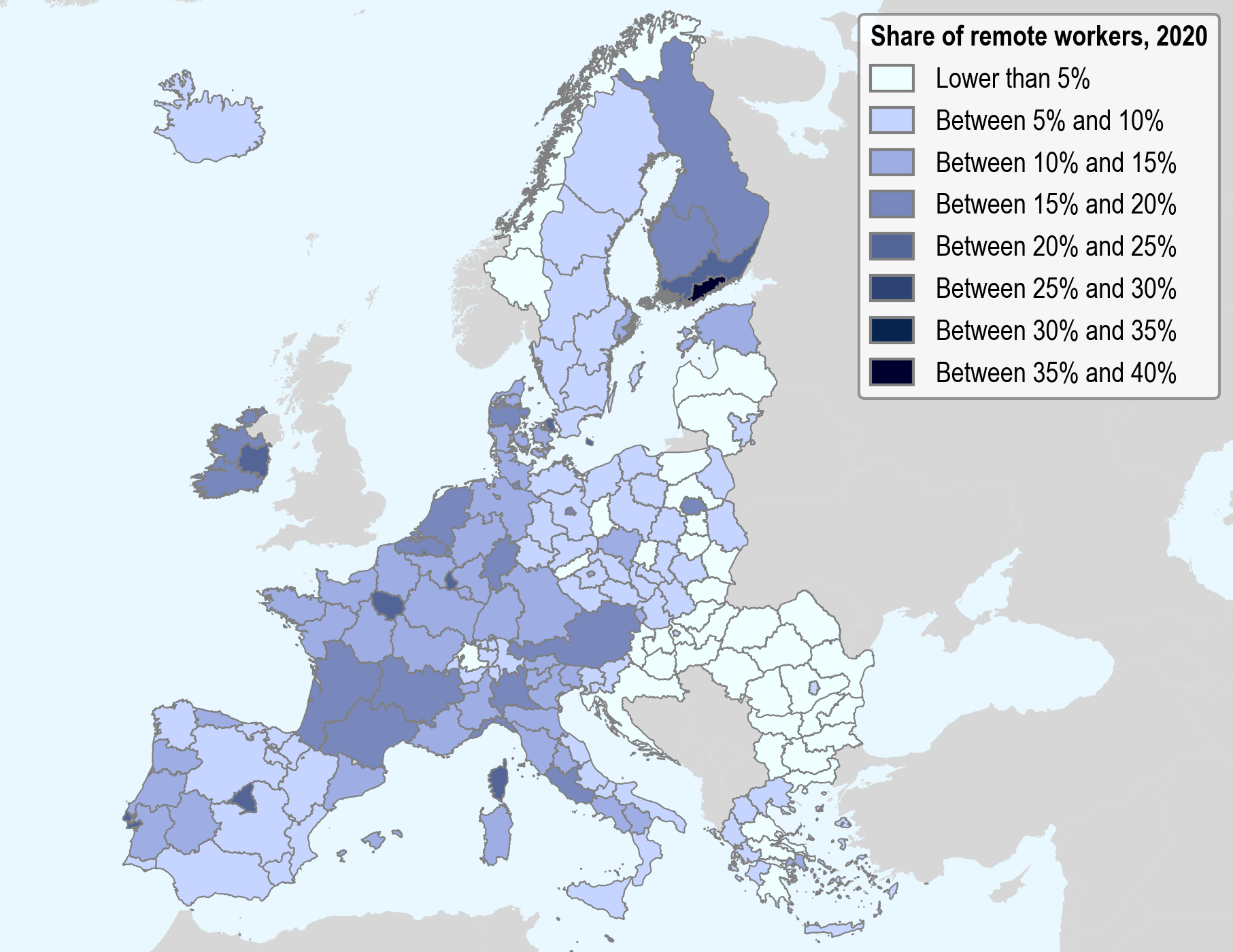
The New Geography of Remote Jobs in Europe
Davide Luca*, Cem Özgüzel*, Zhiwu Wei*# (* alphabetical order, # corresponding author)
Regional Studies, Vol.59, No.1 (2025)
The paper maps the diffusion of working from home across 30 European countries during the COVID-19 pandemic. We summarise the determinants of remote working and show that its uptake was lower than in the United States, and substantially uneven across/within countries, with most remote jobs concentrated in cities and capital regions. We then apply a variance decomposition procedure to investigate whether the uneven distribution of remote jobs can be attributed to individual or territorial factors. Results underscore the importance of composition effects as, compared with intermediate-density and rural areas, cities hosted more workers in occupations/sectors more amenable to working remotely.
The New Geography of Remote Jobs in Europe
Davide Luca*, Cem Özgüzel*, Zhiwu Wei*# (* alphabetical order, # corresponding author)
Regional Studies, Vol.59, No.1 (2025)
The paper maps the diffusion of working from home across 30 European countries during the COVID-19 pandemic. We summarise the determinants of remote working and show that its uptake was lower than in the United States, and substantially uneven across/within countries, with most remote jobs concentrated in cities and capital regions. We then apply a variance decomposition procedure to investigate whether the uneven distribution of remote jobs can be attributed to individual or territorial factors. Results underscore the importance of composition effects as, compared with intermediate-density and rural areas, cities hosted more workers in occupations/sectors more amenable to working remotely.
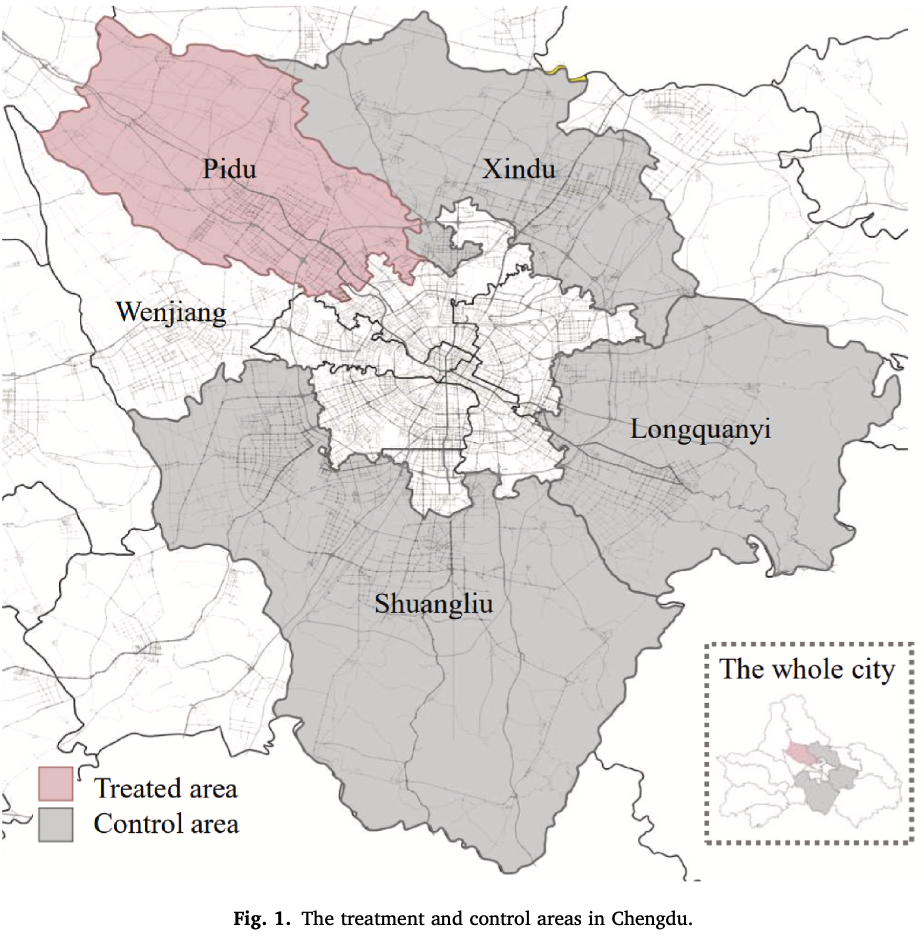
Success in Tandem? The Impact of the Introduction of E-Bike Sharing on Bike Sharing Usage
Qiumeng Li, Davide Luca, Franz Fuerst, Zhiwu Wei
Research in Transportation Economics, Vol.107 (August 2024)
In recent years, shared electric bikes (e-bikes), as a novel shared micro-mobility mode, have experienced a significant increase in popularity. Yet, there is still limited evidence on whether the two forms of micro-mobility act as complements or substitutes. By exploring the effects of the entry of shared e-bikes on bike-sharing and overall shared cycling usage, this paper aims to explore the role of e-bikes in sustainable transportation solutions. The paper combines nearest-neighbour matching and a difference-in-differences event study with bi-monthly panel data of conventional bike-sharing and e-bike-sharing trips from 2020 to 2021. Results suggest that the effect of e-bike-share on bike-sharing at the grid level shifted from an initial complementary effect to a later substitution effect, ultimately resulting in a 22.6% reduction in bike-sharing usage and a 65.9% increase in overall shared cycling usage. The introduction of shared e-bikes simultaneously attracted new user groups and reduced existing barriers to using conventional bikes. With growing market saturation, any further expansion is found to have come to the detriment of the incumbent technology, i.e. the conventional pedal bike. Although shared e-bikes ultimately replaced part of shared bikes, they have increased the overall use of micro-mobility tools, contributing to the popularization of sustainable transportation.
Success in Tandem? The Impact of the Introduction of E-Bike Sharing on Bike Sharing Usage
Qiumeng Li, Davide Luca, Franz Fuerst, Zhiwu Wei
Research in Transportation Economics, Vol.107 (August 2024)
In recent years, shared electric bikes (e-bikes), as a novel shared micro-mobility mode, have experienced a significant increase in popularity. Yet, there is still limited evidence on whether the two forms of micro-mobility act as complements or substitutes. By exploring the effects of the entry of shared e-bikes on bike-sharing and overall shared cycling usage, this paper aims to explore the role of e-bikes in sustainable transportation solutions. The paper combines nearest-neighbour matching and a difference-in-differences event study with bi-monthly panel data of conventional bike-sharing and e-bike-sharing trips from 2020 to 2021. Results suggest that the effect of e-bike-share on bike-sharing at the grid level shifted from an initial complementary effect to a later substitution effect, ultimately resulting in a 22.6% reduction in bike-sharing usage and a 65.9% increase in overall shared cycling usage. The introduction of shared e-bikes simultaneously attracted new user groups and reduced existing barriers to using conventional bikes. With growing market saturation, any further expansion is found to have come to the detriment of the incumbent technology, i.e. the conventional pedal bike. Although shared e-bikes ultimately replaced part of shared bikes, they have increased the overall use of micro-mobility tools, contributing to the popularization of sustainable transportation.
Policy Reports
Mobile Internet Connectivity and Household Wealth in the Philippines (Policy Report)
Neil Lee, Zhiwu Wei, Yohan Iddawela
Asian Development Policy Report 2025 Background Paper, (May 2025)
The rapid spread of mobile internet has had profound economic and social consequences. In this context, understanding how policymakers can improve the economic impact of internet access is an important exercise. In this paper, we seek to understand the conditions under which mobile internet access impacts household wealth in the Philippines. In doing so, we examine factors including the urban/rural divide and the role of education in realizing the returns from better internet connectivity. We adopt an instrumental variable approach using distance to submarine cable landing points as an instrument for mobile internet access. Additionally, we exploit the staggered rollout of 0.27 million geocoded cell towers across the Philippines. Our findings show that mobile internet access significantly increases household wealth, particularly in rural areas and among less-educated households. However, proximity to cell towers appears important for internet quality, with diminished connectivity in regions farther from submarine cable landing points, which may exacerbate regional disparities. Additionally, while internet access boosts employment opportunities for secondary earners, it does not significantly impact overall female employment, which may result from structural barriers. These results suggest the need for policymakers to expand mobile internet coverage in underserved areas and to complement these investments with initiatives to improve internet quality, digital literacy, and access to educational resources. Addressing structural barriers, particularly for women and lower-income households, may also be important for ensuring equitable economic development through internet access.
Mobile Internet Connectivity and Household Wealth in the Philippines (Policy Report)
Neil Lee, Zhiwu Wei, Yohan Iddawela
Asian Development Policy Report 2025 Background Paper, (May 2025)
The rapid spread of mobile internet has had profound economic and social consequences. In this context, understanding how policymakers can improve the economic impact of internet access is an important exercise. In this paper, we seek to understand the conditions under which mobile internet access impacts household wealth in the Philippines. In doing so, we examine factors including the urban/rural divide and the role of education in realizing the returns from better internet connectivity. We adopt an instrumental variable approach using distance to submarine cable landing points as an instrument for mobile internet access. Additionally, we exploit the staggered rollout of 0.27 million geocoded cell towers across the Philippines. Our findings show that mobile internet access significantly increases household wealth, particularly in rural areas and among less-educated households. However, proximity to cell towers appears important for internet quality, with diminished connectivity in regions farther from submarine cable landing points, which may exacerbate regional disparities. Additionally, while internet access boosts employment opportunities for secondary earners, it does not significantly impact overall female employment, which may result from structural barriers. These results suggest the need for policymakers to expand mobile internet coverage in underserved areas and to complement these investments with initiatives to improve internet quality, digital literacy, and access to educational resources. Addressing structural barriers, particularly for women and lower-income households, may also be important for ensuring equitable economic development through internet access.
The New Geography of Remote Jobs? Evidence from Europe
Cem Özgüzel, Davide Luca, Zhiwu Wei
OECD Regional Development Papers, No.57 (November 2023)
The COVID-19 pandemic has led to a dramatic acceleration in the diffusion of remote work. This paper contributes to understanding the phenomenon by offering the first systematic exploration of the uneven diffusion of remote jobs across Europe. Using a combination of rich individual micro-data from the European Union Labour Force Survey and regional-level characteristics, the analysis makes three contributions. First, it provides a systematic approach to measure remote work across 30 European countries. Second, it shows that cities and capital regions adapted faster to remote work than other areas of the continent. Third, it identifies and tests what factors are associated with telework uptake during the pandemic. Results show that the uneven diffusion of remote work is primarily explained by composition effects, i.e., because cities hosted more workers in occupations and sectors more amenable to working remotely.
The New Geography of Remote Jobs? Evidence from Europe
Cem Özgüzel, Davide Luca, Zhiwu Wei
OECD Regional Development Papers, No.57 (November 2023)
The COVID-19 pandemic has led to a dramatic acceleration in the diffusion of remote work. This paper contributes to understanding the phenomenon by offering the first systematic exploration of the uneven diffusion of remote jobs across Europe. Using a combination of rich individual micro-data from the European Union Labour Force Survey and regional-level characteristics, the analysis makes three contributions. First, it provides a systematic approach to measure remote work across 30 European countries. Second, it shows that cities and capital regions adapted faster to remote work than other areas of the continent. Third, it identifies and tests what factors are associated with telework uptake during the pandemic. Results show that the uneven diffusion of remote work is primarily explained by composition effects, i.e., because cities hosted more workers in occupations and sectors more amenable to working remotely.